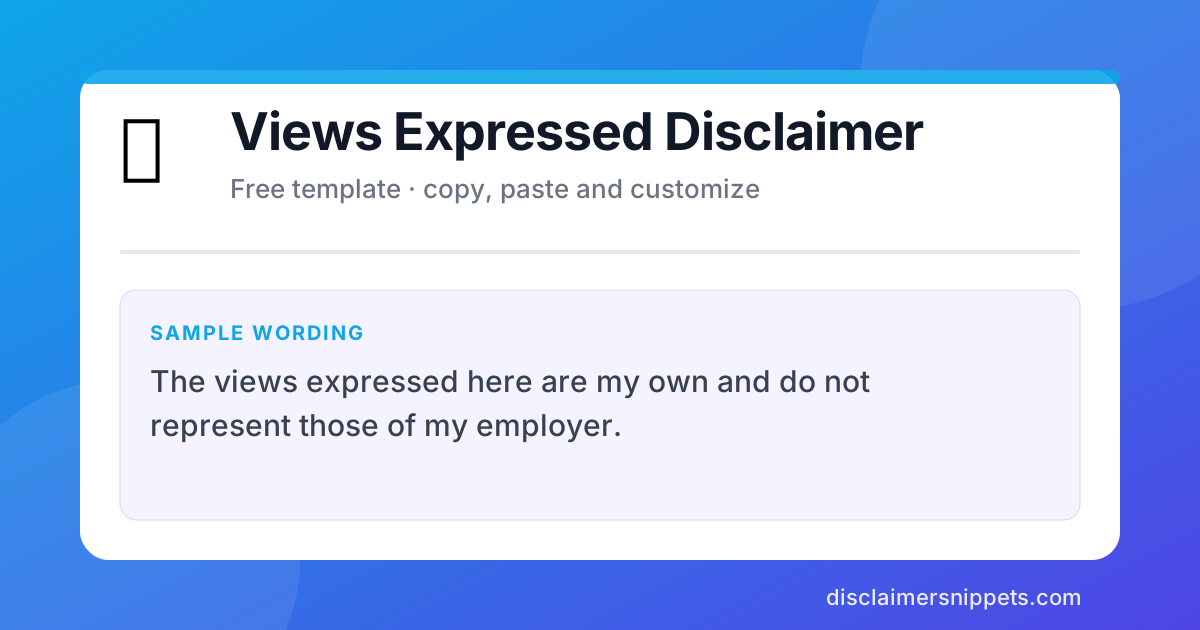
Short views expressed disclaimer example
Use this concise version when space is limited. Replace the bracketed text and make sure it accurately describes your situation.
The views and opinions expressed are those of the author and do not necessarily reflect those of any employer, organization or affiliated entity.
Full views are my own disclaimer template
This longer version provides additional context. Review every sentence before publishing and remove language that does not apply.
VIEWS EXPRESSED DISCLAIMER

The views and opinions expressed on [Website or Channel Name] are solely those of the individual author or speaker. They do not necessarily reflect the official policy or position of any employer, client, organization or other affiliated entity.

Content is provided for general informational and commentary purposes. Any examples are illustrative, and references to organizations or products do not imply endorsement.
Important: This general template is educational information, not legal advice. Requirements vary by jurisdiction, industry and platform. Have a qualified professional review high-risk or regulated uses.
When to use a views expressed disclaimer
- Personal blogs and newsletters
- Podcasts, videos and conference talks
- Social media profiles
- Employee-authored professional commentary
How to write the disclaimer
- Identify whose views are being expressed.
- Name the relevant employer or organization only when necessary.
- Avoid suggesting that a disclaimer overrides workplace policies.
- Use additional disclosures for sponsorships, affiliate links or professional advice.
Disclaimer examples by platform
The same idea can be phrased differently depending on where it appears. A social profile has room for one line, while a podcast or employee blog can carry a fuller statement.
- LinkedIn or X bio: “Views are my own and do not represent my employer.”
- Podcast show notes: “The opinions expressed in this episode belong to the hosts and guests and do not reflect the positions of any company, sponsor or organization they are associated with.”
- Employee blog post: “I work at [Company], but this article reflects my personal views only. It was not reviewed or approved by [Company] and should not be read as an official statement.”
- Conference slide: “The views expressed in this presentation are those of the speaker and not of [Organization].”
Keep the statement close to the content it covers. A one-line version in a bio plus a fuller version in long-form posts is a common pattern; the general purpose of this kind of notice is described in the Wikipedia overview of disclaimers.
Views expressed disclaimer FAQ
Does “views are my own” protect my job?
It does not override an employment agreement, workplace policy or duties owed to an employer. It mainly helps audiences understand who is speaking.
Is this the same as an affiliate disclosure?
No. A views disclaimer identifies the source of opinions; an affiliate disclosure explains a financial relationship. Some content needs both.
Where should it appear?
It may appear in a profile bio, site footer, episode notes or the beginning of a presentation, depending on the context.
What does “views are my own” mean?
It tells readers that opinions belong to the individual speaker or author, not necessarily an employer, client, sponsor or affiliated organization.
Do I need both a views disclaimer and affiliate disclosure?
Sometimes yes. A views disclaimer identifies whose opinion is being expressed, while an affiliate disclosure explains a financial relationship.