Free AI disclaimer generator
Pick how AI was used and the format you need. A short label sits beside one piece of content, while a policy explains your practice on its own page. Your answers stay in this browser.
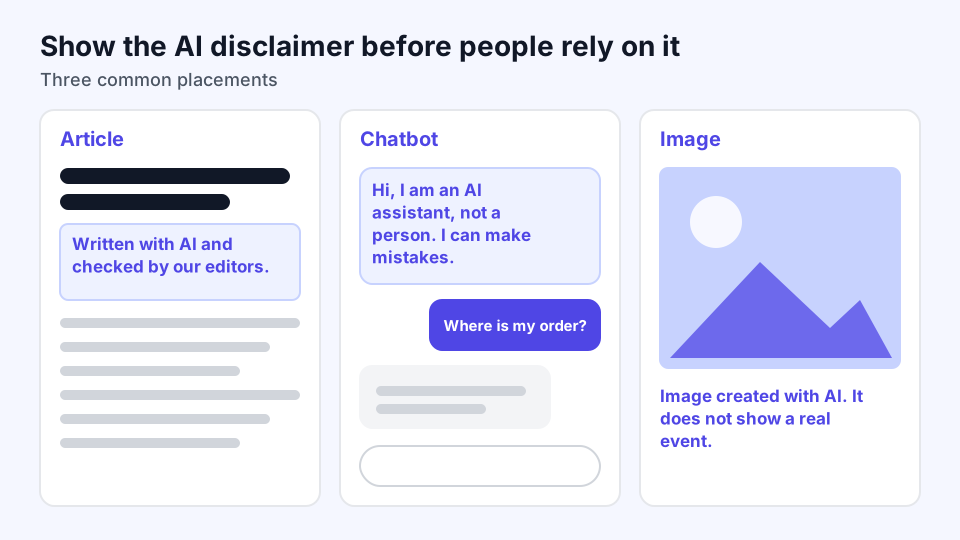
This article was written with AI and checked by our editorial team before publication. [Company Name] remains responsible for what it says.
- Only say a person checked the work if someone really does, every time.
How to write an AI disclaimer with this generator
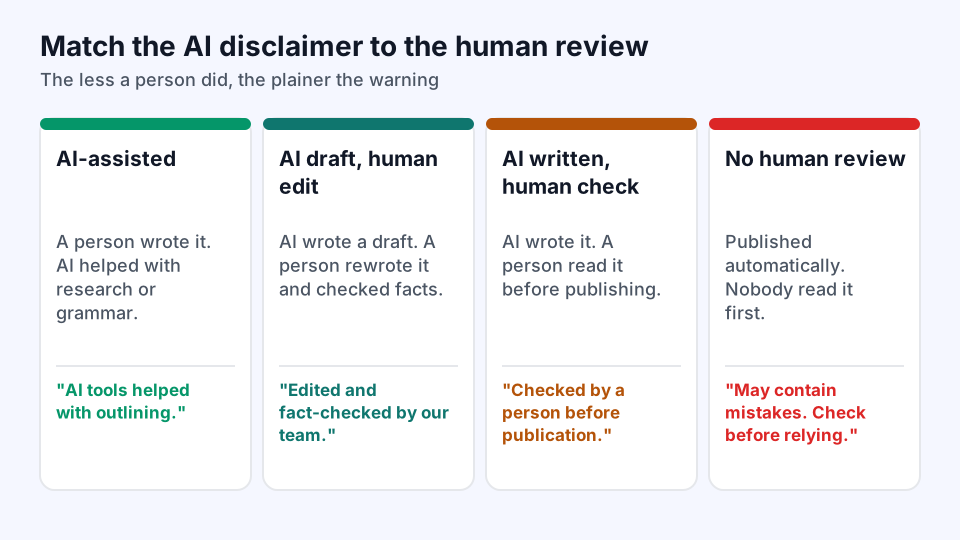
An honest AI disclaimer depends on one fact: how much a person did after the model produced its output. Settle that first, because a label that overstates human review misleads readers more than having no label at all.
- Trace how the piece was made.Ask who wrote the first draft, who changed it and who checked the facts. Answer for this piece rather than your whole site, since different sections may follow different processes.
- Match it to a level.Pick the option that describes your weakest step honestly. If someone skimmed a long AI draft for two minutes, that is closer to no review than to editorial review.
- Say who is responsible.Add the person or team who checks the work. A named reviewer tells readers that someone stands behind the page, which a bare "AI can make mistakes" line cannot do.
- Put the label where people will see it.Use the space under a headline, the first message of a chatbot or the caption of an image. EU rules ask for this information by the first interaction or exposure at the latest, and few readers will ever open a footer link.
- Keep it current.Revisit the wording when your process changes, and add a review date to pages that can go stale.
AI disclaimer examples you can copy
The generator covers the common cases. These samples handle situations that need more specific wording.
AI disclaimer for a blog post
[Author Name] wrote this post and takes responsibility for it. AI tools were used for outlining and for catching grammar errors.
AI disclaimer for a support chatbot
Hi, I'm [Bot Name], an AI assistant for [Company]. I can make mistakes, and I can't change your account or give legal, medical or financial advice. Type "agent" to reach a person.
AI disclaimer for product descriptions
Parts of this description were generated by AI from the manufacturer's specifications. Check the label or ask us before relying on a detail that matters to you, such as ingredients or compatibility.
AI disclaimer for an image
Image created with [Tool]. It is an illustration and does not show a real person, place or event.
AI disclaimer for a research summary
This summary was produced by AI from the documents listed below. Our analysts checked the figures on [Date], but the full documents remain the authority if the two differ.
When an AI disclaimer is required
Many AI labels are voluntary, but some rules make them mandatory. These are the main ones to check for your audience.
- EU AI Act. Article 50 has applied since 2 August 2026. People must be told when they are interacting with AI unless it is obvious, deepfakes must be disclosed, and AI text published to inform the public on matters of public interest must be disclosed unless a person reviewed it and holds editorial responsibility.
- California. The AI Transparency Act took effect on August 2, 2026, after a delay. It targets companies that create generative AI systems rather than publishers using them, so ask your vendor how it handles marking.
- Platforms. YouTube has its own setting for realistic AI content, covered in the YouTube disclaimer generator. Other platforms have similar rules, so check each one you publish on.
- Google Search. Google's guidance on generative AI suggests explaining how content was created where that helps readers. It also warns that mass-producing pages without adding value can breach its scaled content policy, whatever label they carry.
Common AI disclaimer mistakes
- Claiming a review that did not happen. "Reviewed by experts" is a factual claim, and it needs to be true for every page that carries it.
- Using the label to shift blame. "AI may be wrong" tells readers to be careful. It is unlikely to excuse you from publishing something false or harmful.
- Hiding it on a policy page. A policy explains your approach, but readers need the label beside the content.
- Using one label everywhere. A chatbot, a news summary and a stock image raise different questions, so they need different wording.
AI disclaimer FAQ
Do I need an AI disclaimer on every post?
No single rule covers every post. Disclose where the law or a platform requires it, and wherever a reader would feel misled to learn later that AI was involved.
Should an AI disclaimer name the tool?
It is optional. Naming the tool can help on research or creative work, but readers usually care more about what a person checked.
Will an AI disclaimer hurt my Google rankings?
Google's guidance focuses on accuracy, quality and relevance, and it suggests explaining how content was made. It does not describe disclosure as a ranking penalty.
What is the difference between an AI disclaimer and an AI disclosure?
A disclosure says AI was used. A disclaimer limits how far readers should rely on the result. Most good labels do both in two sentences.
Important: AI rules are changing quickly and differ by country. Treat this as a starting draft rather than legal advice, and check the current text of any law that applies to you.