Does "no copyright infringement intended" protect you?
No. The phrase describes your state of mind, while infringement depends on what you copied and whether you had the right to copy it. What you meant can come up later, if a court sets damages. Under 17 U.S.C. § 504, statutory damages normally run from $750 to $30,000 per work, can reach $150,000 for willful infringement and can fall to $200 for someone who did not know they were infringing.
Platforms take the same view. YouTube's fair use page says "no infringement intended" will not automatically protect you from a claim, and that "I do not own" does not mean you have permission. Pixsy and Copyrighted.com reach the same conclusion. There is a practical downside too: the sentence can read as an admission that you knew the work belonged to someone else and used it anyway.
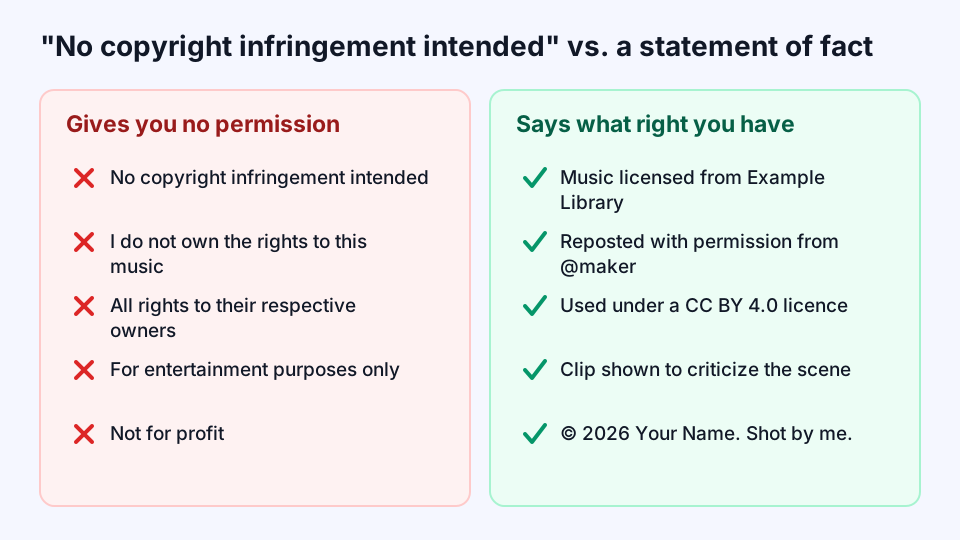
How to replace "no copyright infringement intended"
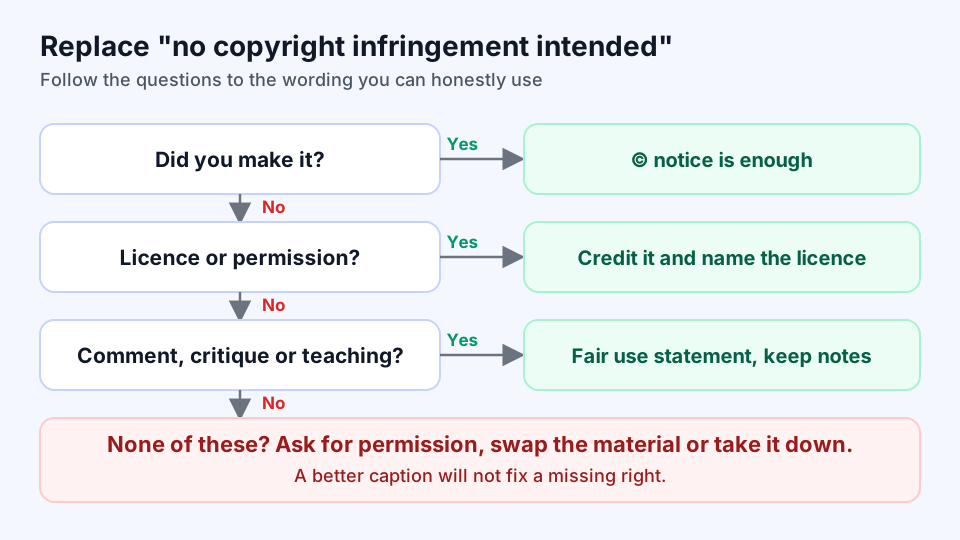
Swap the sentence for a statement of fact about your right to use the material. If you cannot write one, the caption is not your real problem. Work through the questions in this order.
- List what you borrowed.Note each song, clip, photo or quote, who made it and where you found it. Reposts often have several owners, such as a song playing inside someone else's video.
- Check whether you own it.If you created the work yourself, a plain copyright notice is all you need, and the disclaimer can go.
- Look for a licence or permission.Royalty-free libraries and Creative Commons licences set their own conditions, often including exact credit wording. If a creator said yes in a message, keep that message.
- Test the use against fair use.In the US, ask whether you comment on or transform the work, how much you took and whether your version could replace the original. Reposting a whole clip with a caption rarely passes.
- Write the factual line, or remove the material.State who owns the work and what your basis is. If you have no basis, ask for permission, swap in licensed material or take the post down.
Copyright phrases that work no better
You will see these lines under reposts everywhere, and each has the same weakness: none of them supplies a right to use the work.
- "I do not own the rights to this music." It states the problem without solving it, and YouTube says these words do not mean you have permission.
- "All rights belong to their respective owners." This is true of nearly everything, and it says nothing about whether you may use the work.
- "Credit to the owner." Credit is good manners and sometimes a licence condition, but copying a whole work with a name attached is still copying.
- "For entertainment purposes only." YouTube says this is unlikely to help when fair use factors are weighed.
- "Not for profit." Non-profit use is favored, but it is not an automatic defense.
- "I only used 10 seconds." The U.S. Copyright Office rejects the idea of a safe length: it offers no formula for how much you can take.
Better wording than "no copyright infringement intended"
Use the card that matches your situation and delete the rest. Each one only works if it is true.
Copyright credit for licensed music
Music: "[Track]" by [Artist], licensed through [Library or Licence Name].
Copyright credit for Creative Commons work
"[Work Title]" by [Creator], used under [CC BY 4.0], [Link to Licence]. [State any changes you made.]
Copyright line for owner permission
Clip used with permission of [Owner]. All rights in the clip remain with them.
Copyright caption for Instagram or TikTok
Reposted with permission from @[Account]. Original post: [Link].
Copyright statement for commentary
This post quotes [Work] by [Creator] so that I can respond to it. I do not claim ownership of the quoted material, and I believe this use is fair use.
Copyright contact line
If you own something shown here and want it credited or removed, contact [Email]. We reply within [Number] days.
What to do after a copyright claim
A claim is not a court ruling. YouTube lets you dispute a Content ID claim if you have a licence or a real fair use argument, and its guidance says you may need to go further through an appeal and a DMCA counter-notification. Do not dispute just because the caption says you meant no harm, since that gives you no basis. If you lack a licence or a fair use case, the safer choices are to trim the section, replace the audio or remove the upload.
No copyright infringement FAQ
What does "no copyright infringement intended" mean?
The poster is saying they do not mean to break copyright law, and usually that the content is not theirs. It states an intention and carries no legal permission.
Is it illegal to write "no copyright infringement intended"?
The sentence itself is harmless. The legal question is whether you had the right to use the material it sits under.
Does crediting the owner prevent copyright infringement?
Not on its own. Credit matters when a licence requires it, but YouTube says giving credit does not make a straight copy fair use.
How do I say no copyright infringement in an Instagram caption?
Say what right you have instead, such as "Reposted with permission from @name". If you have no permission, ask for it or post something else.
How many seconds of a song avoid copyright infringement?
No safe number exists. The Copyright Office says there is no formula, and YouTube notes that even a small part can fail if it is the heart of the work.
Important: This page is general information, not legal advice. Talk to a copyright lawyer if you have received a takedown or a demand letter.