Fair use disclaimer template
This template works for most media. The brackets matter most, because a statement that names the material and the reason says far more than a stock line.
FAIR USE DISCLAIMER

This [video / article / episode] includes material owned by others, namely [describe the clips, images, music or text]. We use it to [comment on / criticize / teach about / report on] [subject], and we use only as much as that purpose requires.

We believe this is fair use under Section 107 of the U.S. Copyright Act. We do not claim ownership of the original material, and all rights in it remain with its owners.

If you own material used here and have a concern, contact [Email] and we will review it promptly.
Fair use disclaimer examples
Each type of content leans on a different purpose, so the wording should change with it.
Fair use wording for YouTube commentary
I use short clips from [Creator]'s "[Video Title]" to point out [what you discuss]. This is criticism and commentary, which I believe qualifies as fair use. Original video: [Link].
Fair use wording for film and game reviews
Footage from [Title] is shown so that this review can discuss it. All footage belongs to [Studio], and this channel is not sponsored by or connected with [Studio].
Fair use wording for teaching
[Course Name] reproduces short excerpts for teaching and discussion with enrolled students. Each excerpt is limited to what the lesson needs, and full works are available from their publishers.
Fair use wording for a blog
Quoted passages and screenshots on this page are included for commentary and are credited to their authors, who keep all rights in them.
Fair use wording for a podcast
This episode plays brief excerpts of [Work] so that we can discuss them. We believe this is fair use. Support the original at [Link].
Fair use wording for news reporting
Images and excerpts in this report are used to inform readers about [Event] and remain the property of their owners. Sources are credited where they appear.
Fair use wording for memes and social posts
Memes borrow a recognizable frame and change its meaning, which is the kind of transformation fair use looks for. Platforms still remove posts on request, so keep the caption honest and add a social media disclaimer to the profile itself.
This image adapts a frame from [Source] to comment on [Topic]. The original belongs to [Owner]. This post is commentary and parody, not an official release.
Fair use wording for cover art in reviews
Book covers, album art and posters help readers recognize what is being reviewed. Show them at a modest size and only next to the review itself. The copyright disclaimer examples include credit lines for licensed images if you have permission instead.
Cover images identify the works reviewed on this page and remain the property of their publishers and artists. They are shown at reduced size alongside our review.
Fair use wording for software screenshots in tutorials
Step-by-step guides often depend on screenshots of someone else’s interface. Make clear the guide is independent. If the tutorial is a video, the YouTube disclaimer generator can add the description text.
Screenshots of [Software] show the steps described in this tutorial. [Software] is a trademark of [Company]. This guide is independent and has not been reviewed or endorsed by [Company].
How to write a fair use disclaimer
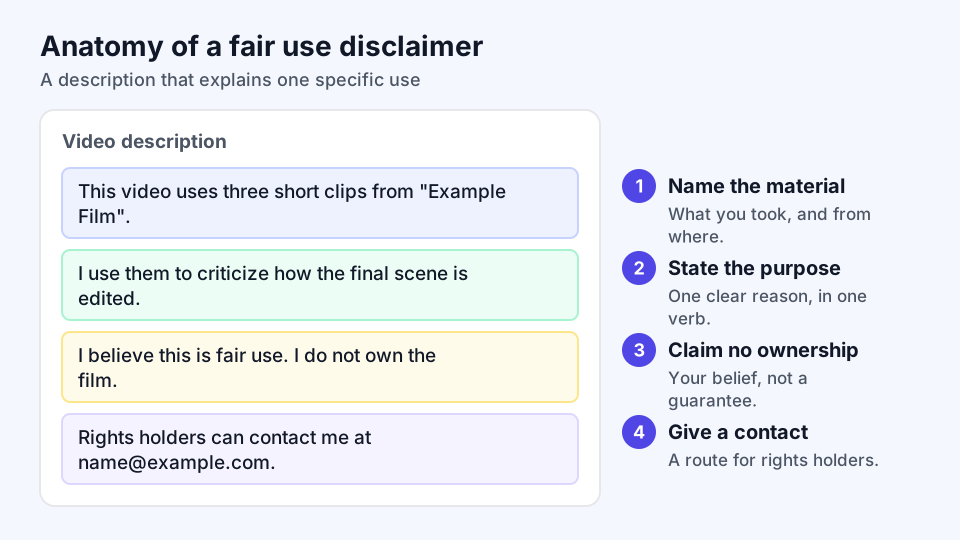
A convincing statement describes one specific use. "Used under fair use" with no detail gives a viewer or a rights holder nothing to assess, so answer these questions instead.
- Name the material.Say what you took and where it came from, such as "three short clips from Example Film" rather than "copyrighted material".
- State the purpose with one verb.Comment, criticize, teach or report. If you cannot pick a verb honestly, fair use may be the wrong basis for this upload.
- Show that you limited the amount.Mention that you used only what your point requires, and check that this is true of the edit before you publish.
- Separate belief from fact.Write "we believe this is fair use", since only a court can decide it, and say plainly that you do not own the original.
- Offer a contact route.Give rights holders an email address. It will not stop a claim, but it can settle a concern before it turns into one.
- Keep private notes.Record why each clip is needed, with timestamps. Those notes matter more than the disclaimer if you ever need to dispute a claim.
The four factors behind a fair use disclaimer
Your disclaimer does not decide fair use. Courts weigh the four factors in Section 107, which the U.S. Copyright Office describes as a case-by-case, fact-specific inquiry. Thinking them through before you upload will tell you whether the statement you are writing is plausible.
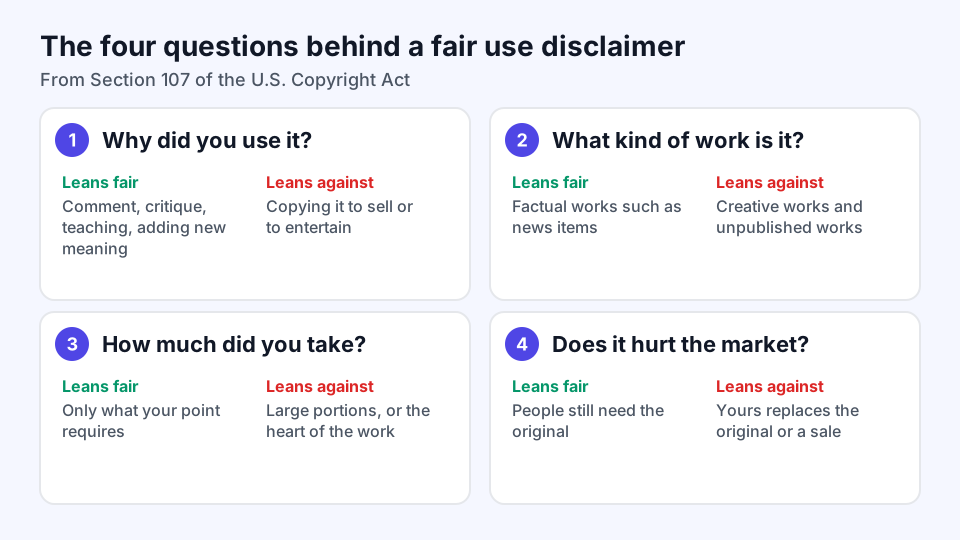
Two points catch people out. No percentage or word count works as a safe harbor, and a small extract can still fail if it is the most important part of the work.
What fair use wording cannot do
- It cannot create fair use. YouTube says no words automatically apply it, and that only courts can answer the question.
- It cannot stop Content ID. Automated systems match content and cannot weigh fair use, so a claim can arrive whatever your description says. You can dispute it if you have a real argument.
- It does not travel. Fair use is a US doctrine. YouTube notes that EU uses must fit categories such as quotation, criticism, review, caricature, parody and pastiche.
- It rarely rescues background music. A song playing under your video usually does not comment on the song, which makes for a weak case. Use licensed music and credit it accurately.
Fair use disclaimer FAQ
Is a fair use statement required?
No. Fair use depends on how you used the work, not on a statement. A disclaimer simply explains your reasoning to viewers and rights holders.
Is there a 30-second fair use rule?
No. The Copyright Office says no fixed amount is guaranteed to be safe, and a few seconds can fail if they are the heart of the work.
Does fair use wording work outside the US?
Fair use is a US rule. Other countries have their own exceptions, often narrower, so check the law where your audience is if that matters to you.
Should fair use wording cite Section 107?
You can, since it names the legal basis. Citing it adds no protection, though, so make sure the rest of the statement explains your actual use.
What should I do after a Content ID claim?
If you honestly believe your use is fair, dispute it in YouTube Studio. If that fails, you may need to appeal and consider a DMCA counter-notification, ideally with legal advice.
Important: This template is general information, not legal advice. Fair use is decided on the facts of each case, so ask a copyright lawyer about anything high-stakes.