Short social media disclaimer
This social media disclaimer suits a brand, nonprofit or public body. Paste it into a profile’s About section or pin it as the first post, then replace the brackets.
Posts on this account share general information from [Organization]. Comments and replies belong to the people who write them, and a like, repost or link is not an endorsement. Messages are checked during [business hours]; for urgent help, contact [Support Link].
Full social media disclaimer template
Publish this version as a page on your website and link to it from every profile. Delete any section that does not describe how you actually run your accounts.
SOCIAL MEDIA DISCLAIMER

[Organization] uses [Instagram, Facebook, TikTok, X and LinkedIn] to share news and general information. This disclaimer covers all of our official accounts.

General information only. Posts are not professional, legal, medical or financial advice, and they may not reflect changes made after they were published. [Website] is the authoritative source for our prices, terms and policies.

Comments and moderation. We welcome discussion and may hide or remove comments that break our comment policy at [Policy Link]. A comment expresses the opinion of the person who wrote it.

No endorsement. Following, liking, sharing or linking to another account or website does not mean we endorse it.

Third-party platforms. Each network is run by a separate company under its own terms and privacy policy, and information you post there is controlled by that company.

Response times. Our accounts are monitored during [business hours]. Do not use social media to report emergencies or to send account numbers or other private details.

Paid content. Sponsored posts and partnerships are marked with the platform’s paid label and stated in the post text.

Employees. Staff posting on personal accounts speak for themselves, not for [Organization].

Questions: [Email Address]
Important: This template is general information, not legal advice. Public bodies, regulated firms and anyone running prize promotions may have extra rules to follow, so have a professional review those uses.
Social media disclaimer examples by platform
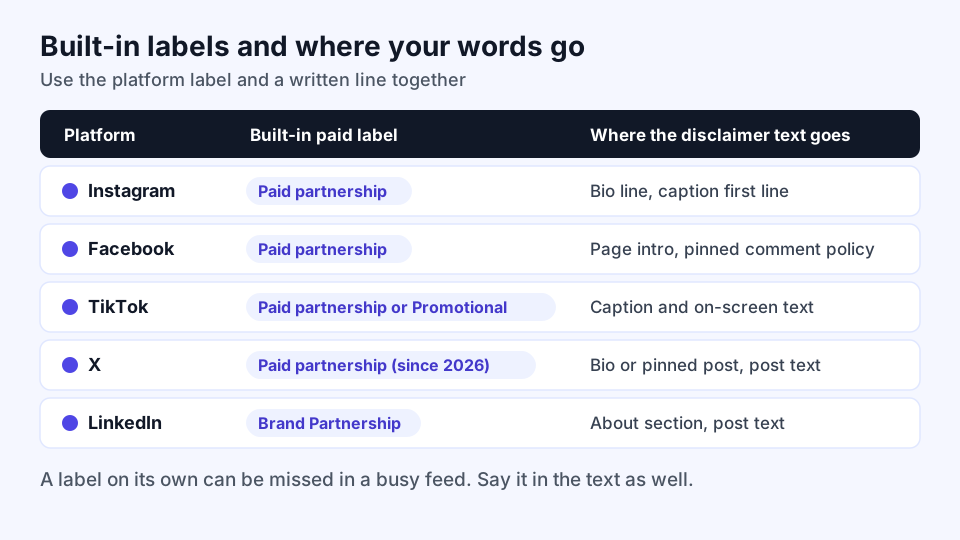
Each network has its own disclosure tool and its own fine print. Use the copy below together with the built-in label, not instead of it.
Instagram disclaimer
Platform rule: Instagram’s promotion guidelines require every giveaway to include a complete release of Instagram by each entrant and an acknowledgement that Instagram does not sponsor or run the promotion. Branded posts should use the Paid partnership label.
This giveaway is in no way sponsored, endorsed or administered by, or associated with, Instagram. By entering, you confirm that you are [18 or older / a resident of Country] and release Instagram from any liability. Official rules: [Link].
TikTok disclaimer
Platform rule: TikTok asks creators to switch on the content disclosure setting for brand content, which adds a “Paid partnership” or “Promotional content” label. The label cannot be changed once the video is live, so set it before posting.
This video shows what worked for me and is for entertainment, not professional advice. Do not copy stunts, challenges or product uses that could hurt you or damage property. [Paid partnership with Brand. #ad]
X (Twitter) disclaimer
Platform rule: X added a native Paid partnership label in March 2026. Creators switch it on from the content disclosure option in the composer, and it can be added after posting. Ads bought through X Ads carry a separate “Promoted” label.
Official account of [Organization]. We post service updates here during [hours]; check [Status Page] for live status. A repost shares news we think is useful and does not mean we agree with it.
Facebook disclaimer
Platform rule: Facebook’s Pages terms apply the same release and acknowledgement rule to promotions, and they do not allow entry methods such as sharing on a personal timeline or tagging friends.
Comment policy: We hide or remove comments that contain threats, hate speech, harassment, spam, scam links or anyone’s personal information, and we may ban accounts that do this repeatedly. We do not remove comments just because they criticize us.
LinkedIn disclaimer
Platform rule: LinkedIn’s Brand Partnership toggle adds a label to posts a company paid for. It is off by default and resets after every post, so switch it on each time. Employees posting their own opinions should use a views expressed disclaimer instead.
Brand partnership with [Company]. They paid for this post and checked it for accuracy before it went live, but the opinions in it are mine.
How to add a social media disclaimer to your accounts
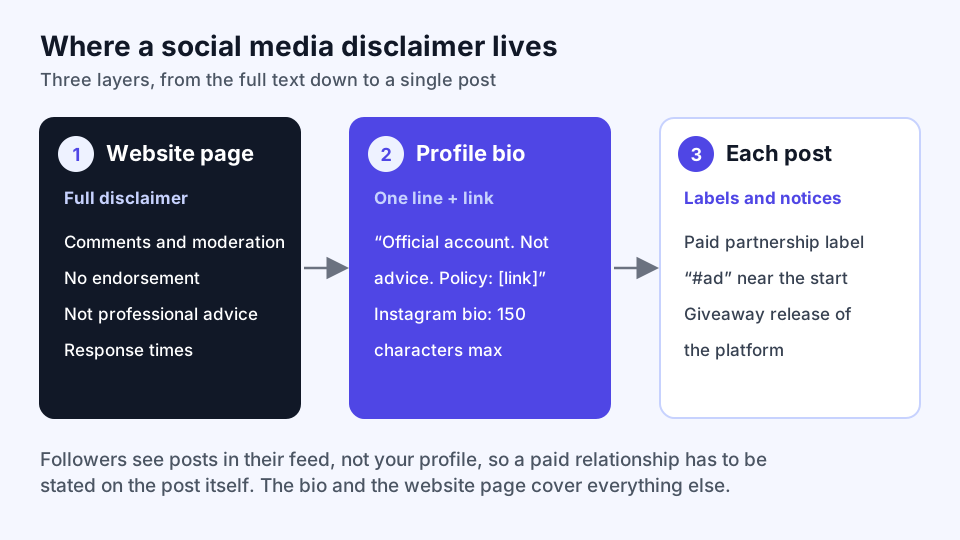
Set this up once for all of your profiles, then repeat only the post-level steps when you publish something paid or run a contest. The FTC’s Disclosures 101 for Social Media Influencers guide explains why the post itself matters most.
- Publish the full version on your website.Put the complete text on its own page and link it from your footer or privacy policy, so every profile has one place to point to. Keep the date of the last update at the top.
- Add a short line to each profile.Bios are tight, and Instagram allows only 150 characters, so write one sentence and add the link. On Facebook and LinkedIn, the About section has room for your comment policy as well.
- Label paid posts on the post itself.Switch on the platform’s paid partnership or brand partnership label, and say it in the text near the start, in words such as “Paid partnership with [Brand].” A tag lost among ten hashtags is easy to miss.
- Put giveaway terms in every promotion.Each contest post needs the platform release and a link to official rules covering who can enter, the closing date and how the winner is chosen.
- Pin the comment policy and apply it evenly.Remove what the policy names, every time. Deleting criticism while leaving spam in place makes the policy look like a pretext.
- Review it when platforms change their tools.Disclosure settings move: X only added its label in 2026. Check each network’s help pages a couple of times a year and update your wording.
What a social media disclaimer cannot do
It cannot turn an undisclosed ad into a disclosed one. Followers meet your posts in their feed, not on your profile, so a line in the bio does not cover a sponsored post that never mentions the sponsor. Endorsement rules apply to each post on its own.
It also does not shield you from what you publish. A false claim about a person, a photo you had no right to use or a misleading health promise remains your responsibility whatever the disclaimer says. Borrowed images need permission or a sound fair use argument, and posts with health or money tips may need a medical or financial disclaimer as well. Videos covering upsetting subjects can carry a content warning before the first frame.
Social media disclaimer FAQ
Do I need a social media disclaimer?
No law requires a general one, but businesses, public bodies and creators use it to set expectations about comments, endorsements and advice. Paid posts are different: in the United States, a material connection with a brand has to be disclosed in the post.
Where do I put a social media disclaimer on Instagram?
Put one short line in your bio with a link to the full version. Wording about a sponsorship or a giveaway goes in the caption of the post it covers, near the start.
Is “views are my own” a social media disclaimer?
It is one kind, written for employees and professionals posting on personal accounts. Brand and organization accounts need wording about moderation, endorsements and advice instead.
Does #ad count as a disclaimer?
#ad is a disclosure rather than a disclaimer. It tells people a post is paid, while a disclaimer limits what the post promises. Many sponsored posts need both.