Documentary disclaimer examples
Match the documentary disclaimer to what you really did in the edit. Viewers can accept a reconstruction when they know it is one.
Reenactment disclaimer
Some scenes in this film are reenactments based on interviews and court records. They use actors and are marked on screen.
Reenactment disclaimer label
Reenactment
Dramatic reconstruction
Artist's impression
Actors portray real events
Dramatization disclaimer
This program includes dramatized scenes. Dialogue has been recreated from [Source], and some events have been condensed for time.
Changed names disclaimer
Some people in this film are composites of more than one person. Certain names and identifying details have been changed to protect privacy.
Based on a true story disclaimer
Based on a true story. Certain events, characters and timelines have been changed for dramatic purposes.
Inspired by true events disclaimer
Inspired by true events. This is a dramatic interpretation and should not be taken as a factual account of the people involved.
AI voice disclaimer
The voice of [Person] in this film was recreated with AI from [Source], with permission from [Estate or Rights Holder]. The words come from their [letters or diaries].
How to add a documentary disclaimer to your edit
Do this once the cut is locked, when you can see what the film actually claims. Decide how each constructed moment will be signaled, then write only the wording you need.
- Mark every constructed moment.Go through the timeline and list reenactments, composite characters, recreated dialogue, compressed timelines and archive footage from a different event than the one described.
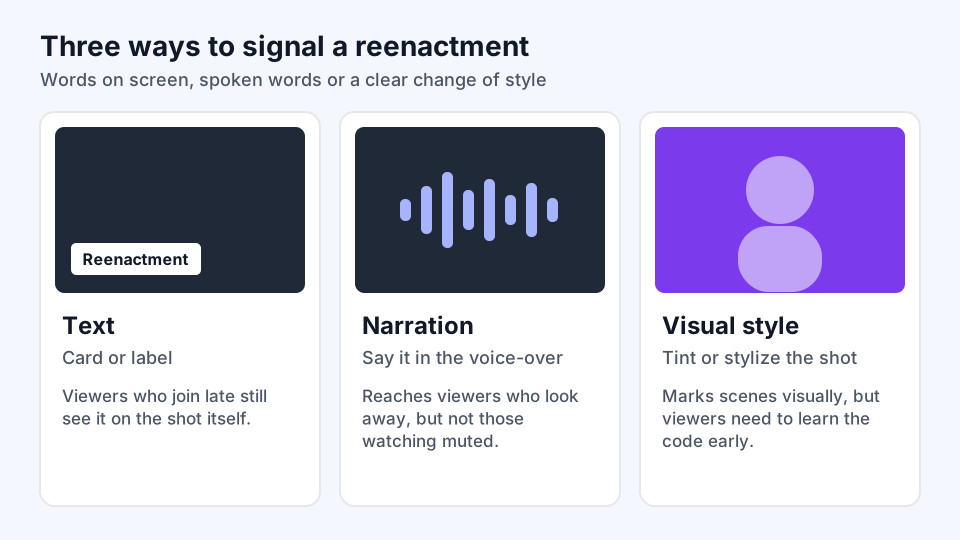
- Choose how viewers will know.A card, a label, narration and a change of visual style can all work. Choose what suits the film, and apply it the same way each time.
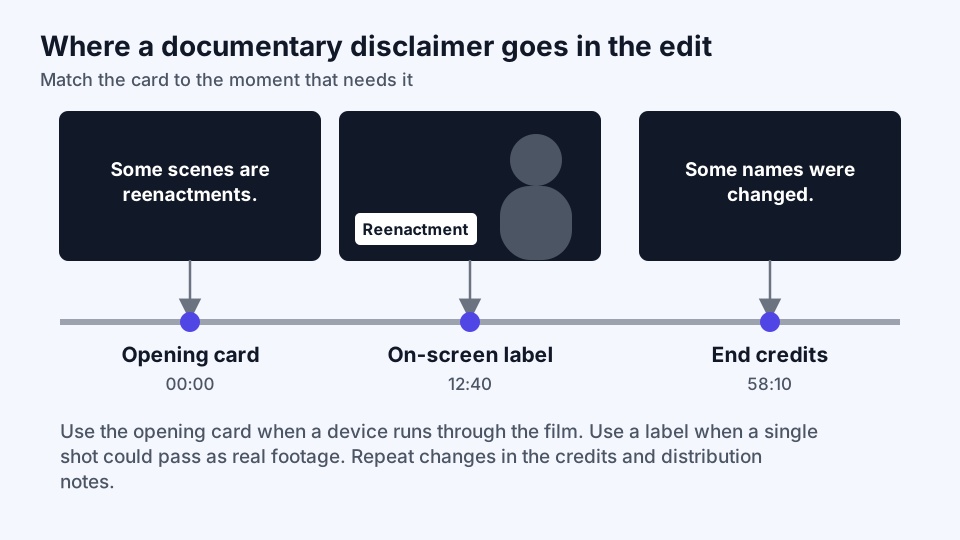
- Write an opening card for whole-film devices.If reconstruction runs through the film, say so at the start, before viewers begin taking scenes as footage.
- Add a label to shots that could pass as real.Single shots that look like archive or surveillance footage need a label on the shot itself. Keep it on screen long enough to read.
- Repeat changes in the end credits.Note changed names and composites in the credits and distribution notes, so that broadcasters and platforms can see what was altered.
- Have counsel check portrayals.Ask a media lawyer to review any scene showing an identifiable person doing something they might dispute.
How a documentary disclaimer signals a reenactment
Broadcast standards give a useful benchmark. PBS's editorial standards say re-creations of real events should be as accurate as possible and clearly identified, whether through verbal or text disclosures or through obvious stylization. Those standards bind PBS producers rather than everyone, but they are a sensible model for an independent film as well.
Documentary disclaimer or fiction disclaimer?
Use a documentary disclaimer for material you present as fact, and a movie disclaimer for invented stories. The two should not be swapped. The classic "all persons fictitious" line tells viewers nothing is real, which would undercut a factual film and could look misleading if the film names real people.
Scripted drama drawn from real events sits between them. Screenwriting guides treat "based on a true story" as closer to the facts than "inspired by a true story". Choose the phrase that matches how much you changed, and if most of the plot is invented, the looser one is the honest choice.
What a documentary disclaimer cannot do
A card does not cure a false statement about a real person. If a reenactment shows someone doing something they did not do, a disclaimer may not protect you from a defamation claim. Rely on your evidence, your releases and a lawyer's review instead.
It does not clear rights either. Archive footage and music need a licence or a sound fair use argument, whatever the card says. Opinions from interviewees can be handled with views expressed wording if your distributor asks for it.
Documentary disclaimer FAQ
Do documentaries need a disclaimer?
No general law requires one, but broadcasters and distributors may. PBS, for example, expects re-creations to be clearly identified.
What should a reenactment disclaimer say?
Say that the scene is a reenactment and, where it helps, what it is based on, such as interviews or court records. "Reenactment" on screen is often enough for a single shot.
Where does a documentary disclaimer go?
Use an opening card for devices that run through the film, an on-screen label for individual shots and the end credits for changed names and composites.
Can I say "based on a true story" if I changed a lot?
Be careful. If much of the plot is invented, "inspired by true events" describes it better. Either way, add a line saying that events and characters were changed.
Does a documentary disclaimer stop a defamation claim?
No. It tells viewers what was reconstructed, but it may not protect a false factual claim about an identifiable person.